
Keeping it interesting.
One of the major components that differentiates a set from another in Magic is the mechanics introduced, or reintroduced between sets. They define how your set plays, they outline themes, they’re the literal mechanical identity of the set.
I knew pretty early on that I would have no shortage of mechanics to transpose over from Monster Hunter, and some of the first few that I sort of took and ran with is that of the status ailments – namely
Poison, Sleep, and Paralysis.
In Monster Hunter, these are what are known as “Abnormal Status Effects” that can both be applied to and applied by the player. Essentially, if you hit the monster enough (or the monster hits you enough), a negative debuff gets applied. In the case of Sleep and Paralysis, you’re rendered immobile and vulnerable for a period of time, while Poison has you taking damage over time.


So, I knew that I wanted these effects in my set in some way, as many monsters are based off of these statuses as well as the player themselves being able to apply them likewise.
The astute of you may already know though, that “Poison” is already an existing mechanic within Magic. Creatures with Poison apply an amount of poison counters to a player when they deal combat damage, and if a player reaches 10 poison counters, they lose the game.
Well, if it isn’t broke – Don’t fix it.
Poison.
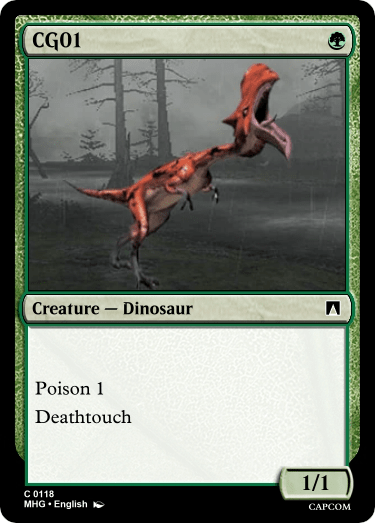
Here we have a classic adaptation of the 1/1 deathtouch creature for one green, now made even deadlier.
Poison will be primarily focused in Green, with the idea being that I don’t want players to be able to easily splash into a Poison theme, if you want to play the Poison deck, you need to be pretty committed to Green. That being said, if a 1/1 Poison creature hits you 10 times, something is most definitely going wrong anyway. Deathtouch is a nasty little sting to put on a creature you already don’t want hitting you though.
Sleep.
Sleep isn’t an existing mechanic within Magic, but it is definitely an effect with an established connotation – one established by cards such as:
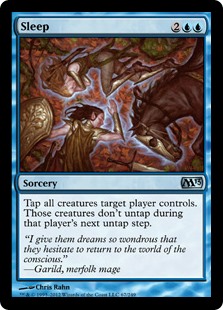
So, naturally, I knew that something of this nature would be the end result of my sleep mechanic. How do we get there though?
Well, I find mechanics are easier to understand when you can relate them to something else. “It’s like X but Y” is often a very effective way to get someone to an immediate level of understanding. That being said –
It’s like Poison, but for Sleep.
In Monster Hunter, to apply sleep to a monster, you have to hit them with a sleep weapon numerous times – the same is true for applying Poison with a poison weapon, and (spoiler) applying paralysis with a paralysis weapon.
So, the way my Sleep mechanic works is like this:
Sleep X – When this creature deals combat damage to a player, that player gets X Sleep Counters.
When you reach 10 Sleep counters, you don’t immediately lose the game, but you do fall asleep.
At the beginning of the asleep player’s next upkeep, tap all creatures that player controls. They do not untap during their controller’s untap step for as long as they are asleep.
Alright, so being asleep means all your creatures are tapped down and you’re left wide open. How do you wake up though?
The next time a sleeping player would take damage, double that damage and remove all sleep counters from that player.
Ouch. It’s a hefty payoff – maybe not as hefty as “You Lose the Game” but still hurts. Sleep is going to be most present in Blue and White creatures of the set, as a sort of long term control payoff – After all, after they’ve been slept, you can wake them up at your leisure.
The fact that Sleep is not an instant loss condition means that it can be applied more liberally to creatures where it fits, instead of very cautiously as is generally true of Poison creatures. You can also expect some counter manipulating shenanigans out of this set like counter doublers, removers, solemnity effects and otherwise.
A couple important things to note are that only the next INSTANCE of damage is doubled, and in the case of multiple attacking creatures, the attacker chooses which deals damage first. As well as this, creatures played AFTER a player has fallen asleep still tap and untap as normal, its only upon reaching 10 Sleep counters that they all “fall asleep.”
Lets move on.
Paralyze.
Well, having seen Poison and Sleep, you can probably guess how this mechanic will work. You hit your opponent a lot, apply 10 Paralysis counters and then . . .
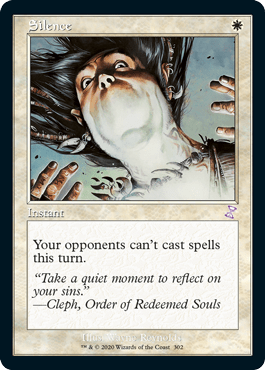
When a player reaches 10 paralysis counters, they become Paralyzed. On a paralyzed player’s next upkeep they remove all paralysis counters and cannot cast spells that turn.
So, obviously this is an even weaker payoff than the others – not negligible but certainly not on the same scale. This is because I intend for this to be used by more aggressive decks as a sort of aggro payoff. Creatures with Paralyze will be fast, tempo oriented creatures and the Paralyze keyword will often come with higher increments, potentially allowing for multiple applications of Paralysis in a single game.
Red and Black will be the two colors working with Paralyze, mostly to be in direct contrast to Blue and White’s Sleep.
These three mechanics I expect to be a pretty substantial hurdle to balance, one that I won’t be able to tweak much until playtesting, but I do think that Poison counters is a mechanic worth elaborating on and expanding like this.
That’s all for now, remember not to let the Poison creatures through.
If you can help it.


Leave a comment